
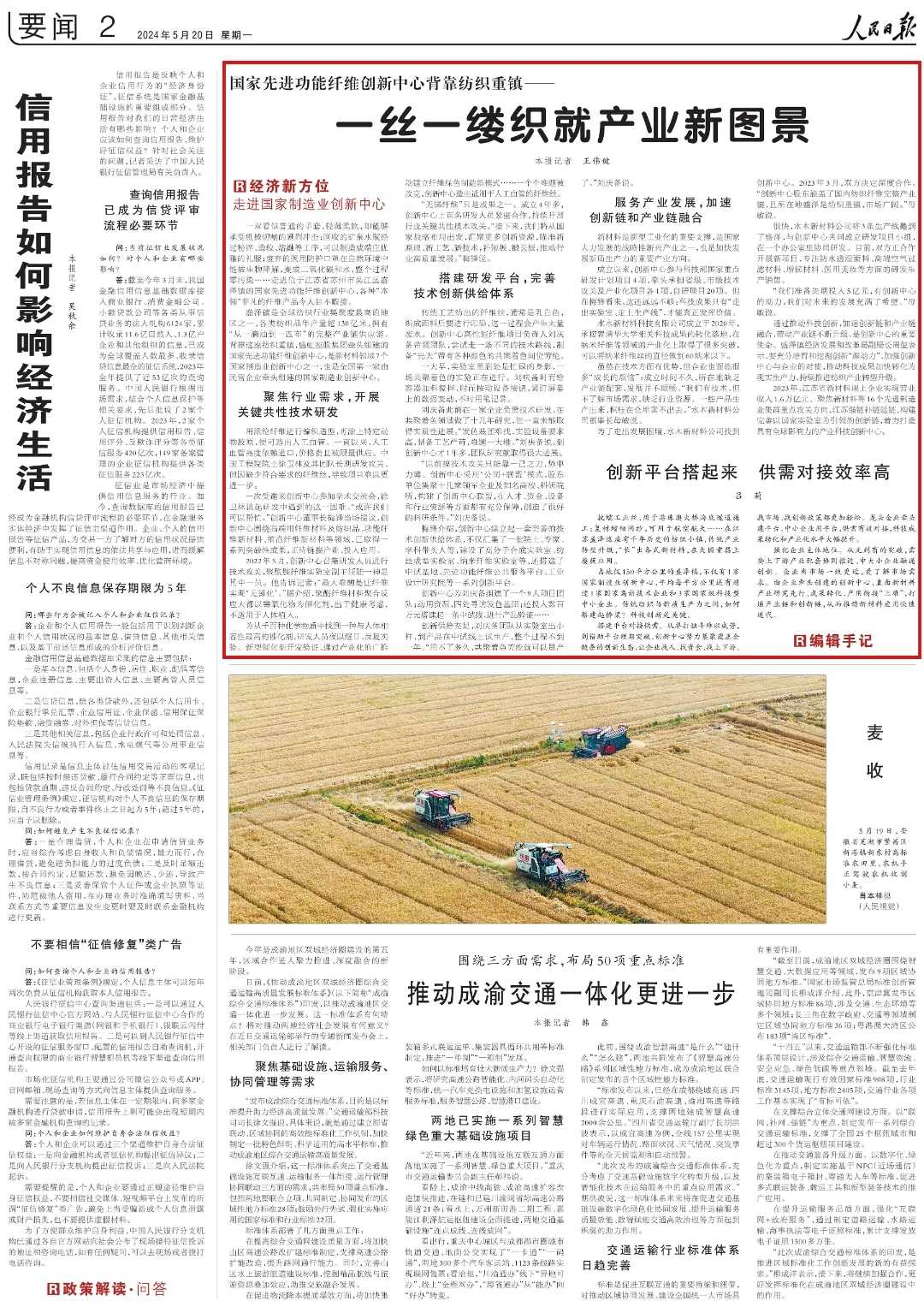
On May 20th, the People's Daily published a front-page article on page 2 tenitled "National Advanced Functional Fiber Innovation Center Backed by a Textile Hub—Weaving a New Industrial Landscape with Every Thread," reporting on the National Advanced Functional Fiber Innovation Center, spearheaded by the Shenghong Holding Group. The article elaborates on how the National Advanced Functional Fiber Innovation Center promotes the rapid iteration of new material applications through technological innovation, focusing on three aspects; conducting research and development in to key common technologies, improving the technological innovation supply system, and accelerating the integration of the innovation and industrial chains.
The following is the full text of the report:
A pair of seemingly ordinary gloves, light and soft, can withstand the violent impact of mechanical cutting; recycled mineral water bottles can be made into dignified and elegant dresses after crushing, granulation, melting and other processes; discarded medical protective masks can be biodegraded in the natural environment into carbon dioxide and water, and the whole process is zero pollution... Walking into the National Advanced Functional Fiber Innovation Center in Shengze Town, Wujiang District, Suzhou City, Jiangsu Province, all kinds of fiber products with extraordinary "skills" are overwhelming.
Shengze Town is one of the regions with the greatest textile-industry concentration in the world. Its annual output of various textiles exceeds 13 billion meters, and it has a complete industrial chain supply chain of "from a drop of oil to a piece of cloth". Backed by this textile powerhouse, the National Advanced Functional Fiber Innovation Center, spearheaded by the Shenghong Holding Group, is one of the seven national manufacturing innovation centers in the field of new materials, and also the first national manufacturing innovation center in China led by a private enterprise.
Focus on industry needs to carry out key common technology research and development
Artificial blood vessels can be created by weaving polyester fibers into shapes and then coating them with specific animal collagen. For a long time, artificial blood vessels have been heavily reliant on imports, resulting in high prices and limited supply. Academician Xu Weilin of the Chinese Academy of Engineering and his team have been working on this research for a long time, but the lack of suitable fiber filaments has hindered the project's progress.
During an academic exchange meeting at the Innovation Center, Xu Weilin discussed this difficulty he encountered in his research and development. "Perhaps we can help," suggested Mei Feng, Chairman of the Innovation Center. The Innovation Center has already achieved a series of breakthroughs in the fields of high-end fiber materials and textiles, functional fiber new materials, and cutting-edge fiber new materials, and is now ready to connect with industries and put them into application.
In May 2022, the Innovation Center convened a team of researchers to tackle key technical challenges, including Lu Yishen, deputy director of the polyamide fiber laboratory. He told reporters, "The biggest challenge is to make the fiber 'antimony-free'." It is understood that the polymerization reaction of polyester fiber materials mostly uses antimony oxide as a catalyst, which is unsuitable for human implantation due to health concerns.
To find the catalyst with the highest biocompatibility among hundreds of chemical substances, researchers worked day and night, conducting repeated experiments. The development and verification of new catalysts, the promotion of industrialization to establish a new model for green fiber manufacturing… one challenge after another was overcome, and the innovation center created fiber filaments suitable for artificial blood vessels.
"Antimony-free fiber" is just one of the achievements. In the four years since its establishment, the innovation center has seen over a hundred researchers working closely together to continuously tackle key common technologies in the industry. "Next, we will start from the national strategic layout, gather more innovation resources, target new principles, new processes, and new technologies, address weaknesses and strengthen strengths, and promote high-quality development of the industry," said Mei Feng.
Build a research and development platform to improve the supply system of technological innovation
Traditionally spun fibers are typically milky white. After being woven into fabric, they require dyeing, a process that generates a large amount of wastewater. Liu Qingbei, head of the high-performance fiber project at the Innovation Center, led his team to explore a different technological route, preparing copolymer-dyed meta-aramid fibers that are "naturally" colored in various hues.
Early in the morning, the laboratory was bustling with activity as a copolymer staining experiment was underway. Liu Qingbei was constantly adding and stirring the container, pressing buttons on the equipment, keeping a close eye on the data changes on the screen, and taking notes from time to time.
Liu Qingbei previously worked in a company in charge of technology research and development, where he conducted research in the field of copolymer coloring for more than ten years, but had not made any substantial progress. "The chromophores are hard to find, the experimental equipment requirements are high, the preparation process is rigorous, and there are a lot of problems," Liu Qingbei said. He added that in just over a year since joining the innovation center, his team has made great progress in their research.
“In the past, tackling key technological challenges could only be done by one person, which was weak and ineffective. The innovation center adopts a ‘company + alliance’ model, with shareholders including more than a dozen leading enterprises, well-known universities, and research institutes, forming an innovation center alliance. This provides ample support in terms of talent, funding, equipment, and industry resources, creating excellent research conditions,” said Liu Qingbei.
Mei Feng explained that the Innovation Center has established a complete technological innovation supply system, which not only brings together a group of academicians, experts, and discipline leaders, and has built laboratories such as polymer synthesis, spinning and forming, and nanofiber, but also has built a series of innovation platforms such as pilot-scale production base, advanced functional fiber public service platform, and industrial design research institute.
The Innovation Center assembled a 9-person project team for Liu Qingbei, mobilized resources to search for chromophore groups, and invested millions of yuan to build a pilot production line for product verification...
With ample supply of innovative products, Liu Qingbei's team went from producing small samples in the laboratory to pilot production on a pilot line in less than a year. "It won't be long before copolymer-dyed aramid can be mass-produced," Liu Qingbei said.
Service industry development to accelerate the integration of the innovation and industrial chains
New materials are an important support for new industrialization, one of the strategic emerging industries that the country is vigorously developing, and an important industrial direction for accelerating the development of new quality productive forces.
Since its establishment, the Innovation Center has participated in four national key research and development plan projects of the Ministry of Science and Technology, led one provincial and one municipal technology and one industrialization project each, and 20 self-developed projects. But in Mei Feng's opinion, this is far from enough; scientific and technological achievements can only be truly valuable if they "go out of the laboratory and onto the production line".
Founded in 2020, Shuimu New Materials Technology Co., Ltd. has undertaken the transformation and implementation of the relevant scientific and technological achievements of Tsinghua University. It has made many breakthroughs in the industrialization of nanofibers and other fields, and its diameter of nanofiber filaments can now be less than 60 nanometers.
Despite its technological advantages, the company also faces many "growing pains”. It is a relatively new company, its location lacks supporting industrial chains, and its development is not smooth. "We have the technology, but we don't understand market demand and lack industry resources. Some products are produced but remain unsold in warehouses," said Mu Min, chairman of Shuimu New Materials.
To overcome its development difficulties, Shuimu New Materials approached the Innovation Center. In March 2023, the two parties decided to deepen their cooperation. "The Innovation Center's shareholders cover the entire domestic textile fiber industry chain, and its location, Shengze, is a major textile town with a vast market," said Mu Min.
Shuimu New Materials hence soon moved three production lines to Shengze and set up a project group with the innovation center to cooperate in research and development. At present, the two sides are cooperating to carry out new projects, focusing on the research and development, production and sales of waterproof and moisture-permeable fabrics, high-end air filtration materials, toughening materials, medical cosmetics, etc.
"We are ready to invest 500 million yuan in advance. With the help of the innovation center, we are full of hope for future development." Mu Min said.
Promoting technological innovation, accelerating the integration of the innovation chain and the industrial chain, and driving the continuous upgrading of the industrial chain are important missions of the innovation center. Zhou Xi, deputy director of the Economic Development and Reform Bureau of Shengze Town, said that it is necessary to fully cultivate and explore the "driving force" of innovation, strengthen connections between the innovation center and enterprises, promote the rapid transformation of scientific and technological achievements into real productivity, and continuously promote the transformation and upgrade of the textile industry.
In 2023, Jiangsu Province's new materials enterprises above designated size achieved operating revenues of 1.6 trillion yuan. Focusing on key research areas in 16 advanced manufacturing clusters, including new materials, Jiangsu is strengthening, supplementing, and extending its industrial chains, building a comprehensive innovation chain led by national laboratories, and striving to create a globally influential industrial science and technology innovation center.
Editor's Notes of People's Daily
Anti-creep industrial yarns were used in the construction of the Hong Kong-Zhuhai-Macau Bridge undersea tunnel; composite toughened mesh can be used in aerospace... In Shengze, Jiangsu, a textile town with a thousand-year history, traditional industries are transforming and upgrading, "growing" various new materials that can be repeatedly applied in major national projects.
Shengze Town, covering only 150 square kilometers, boasts not only a national manufacturing innovation center, but also more than one national high-tech enterprise and three national-level science and technology-based SMEs per square kilometer. How can a bridge be built between traditional textiles and new-type productivity? Technological innovation is key.
Building platforms to connect supply and demand. Moving from the difficulty of achieving significant results through individual efforts to leveraging platforms for short-term breakthroughs, the innovation center strives to cultivate an innovation ecosystem covering the entire value chain, making it easier for companies to find talent, funding, upstream and downstream partners, markets, and innovation policies. Leading enterprises spearhead the platform's construction, while SMEs utilize it, effectively connecting supply and demand and significantly improving the level of technology transfer and industrialization.
Strengthening the leading role of enterprises. Breakthroughs from scratch require coordinated efforts across upstream and downstream industries, as well as collaborative innovation among enterprises of all sizes. Enterprises are closer to the market and have a better understanding of market demands. Innovation centers established by enterprises directly address the three major challenges in the new materials industry; pioneering research, commercializing research results, and bridging production and application. By connecting the industrial chain and the innovation chain, they can drive the rapid iteration of new material applications.


